

Bitcoin!…I would have not written over Bitcoins, but I am impelled to write over it, as wherever I go people are just asking about Bitcoins. But most importantly most of them expect an answer that they already have in their mind. They just ask me to have a feel that they are right this time.
Just to share with you, one of my relative asked me “What’s your take on Bitcoins?” I told him same what I am about to share with you in this article. His answer was awesome. He said “Yaar thodi aur detail mein research kar. Yeah sahi lag raha hai.” Then I finally decided to write something over it.
What is Bitcoin?
Technology has made the world a smaller place over recent years. Bitcoin is a child of the technological revolution.
Bitcoin was the first of what have become known as “cryptocurrencies”. These are forms of digital money that use encryption to secure transactions and control the creation of new units. It is produced by people and businesses all over the world using advanced computer software that solves mathematical problems.
Bitcoin does not flow through the traditional banking system; rather it flows from one computer wallet to another. Bitcoin cannot be held or kept in a pocket or wallet like currency; it is purely a computer-based means of exchange, with low transaction fees.
The idea was to make a form of currency not controlled by governments or businesses that you could trade globally with no cost and without having to reveal your identity.
Is Bitcoin a Currency?
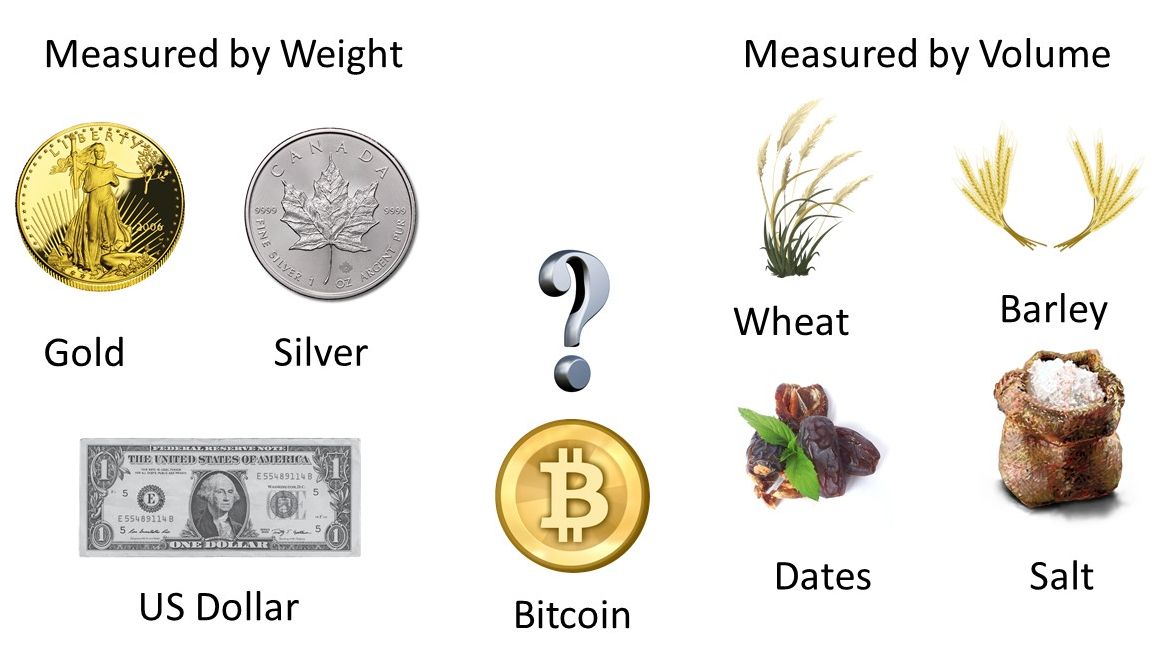
There is a great deal of debate about whether Bitcoin is a currency. The Merriam-Webster Dictionary defines currency as:
- Circulation as a medium of exchange
- General use, acceptance, or prevalence
- The quality or state of being present
- Something (like coins, treasury notes, and banknotes) that is in circulation as a medium of exchange
- A comment article used for barter
The official definition of currency may leave you more confused about whether Bitcoin is a currency or something else. After all, it certainly meets some of the characteristics in the definition, but not others.
Currency in general has a derived trust value which makes it little stable, not like crytocurrencies which has huge volatility.
In September 2015, the Commodity Futures Trading Commission (CFTC) in the United States officially designated Bitcoin as a commodity….which again started new discussions & confusion over Bitcoin
Origin of Bitcoin
The origins of Bitcoin trace back to 2008, when its creator, who went by the pseudonym Satoshi Nakamoto, published a proof of concept for Bitcoin. Nakamoto left the project in 2010 and disappeared, but other developers picked up the work. Bitcoin’s birthday is Jan.3, when Nakamoto mined the first 50 units of the currency.
Nakamoto only communicated by email and social messaging. While several people have been identified as likely candidates to be Satoshi, as the creator is known in the world of Bitcoin, not one has been confirmed. So the search for Satoshi has gone on.
Bitcoin is not the only cryptocurency
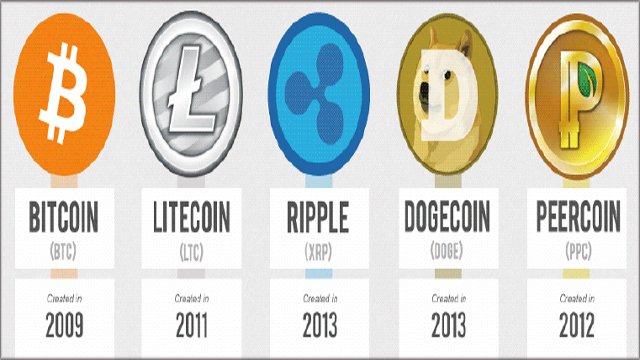
There are almost 800 digital currencies globally, as of today. However closest rivals of Bitcoin are Ethereum, Bitcoin Cash, Ripple and Litecoin
First Recorded transaction
The first transaction involving bitcoin was reported on May 22, 2010, when a programmer identified as Laszlo Hanyecz said he “successfully traded 10,000 bitcoins for pizza.” As of Nov. 28, 2017, 10,000 bitcoins are worth about $99 million.
Banks & Governments stance on Bitcoins?
Vietnam has introduced a ban on Bitcoin and other virtual cryptocurrencies, echoing a similar move made by China recently.
The country’s state bank issued a formal statement prohibiting the use of virtual currencies to pay for goods and services. The punishment for offering and accepting payments in Bitcoin can run to over £6,000.
In September, Chinese regulators passed a “comprehensive ban” on platforms allowing people to buy or sell virtual currency like Bitcoin or Etherium (another cryptocurrency).
Bitcoin – and other decentralised cryptocurrencies – allow people to trade directly with each other, cutting out the need for a middleman which, in traditional commerce, is a bank. Banks have created a level of trust that transactions pass smoothly and everything is recorded and accounted for correctly.
According to the Financial Times , even British banks are starting to shun companies that deal in Bitcoin.
Is Bitcoin a Bubble?
Every now and again, people get over-excited about something and then its price takes on a life of its own.
A good idea gets jumped on by investors, others see price rises and start buying in, then it crosses over to the general public – who see huge price rises and start throwing more money at it.
At the start of the rise more and more people look to get involved over fear of missing out and then – like all bubbles – it bursts.
This isn’t a new thing, way back in 1841 Scottish journalist Charles Mackay published a book – Extraordinary Popular Delusions and the Madness of Crowds – outlining at least three of them that he had seen evidence for.
We didn’t learn – with everything from the 1929 stock market rise, the 1990s mania for tech stocks and more all following the same route as Tulip Bulbs in 18th century Holland.
The stages of a bubble
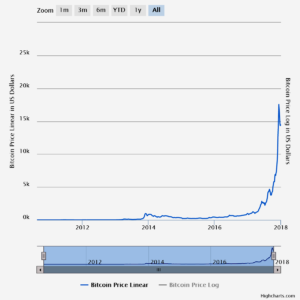
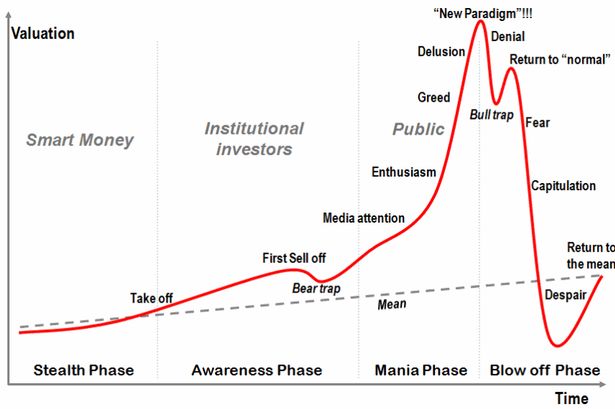
Based on Dr Jean-Paul Rodrigue of Hofstra University’s anatomy of a bubble chart And Bitcoin.
The big question is whether we have reached the euphoric stage or are still in the boom phase.?”
The problem with digital ‘currencies’
Yellow road warning sign , Problems Ahead , 3d render
Ambiguity in Valuation
Normally, the value of a currency is backed up by a country’s central bank – or in the case of the euro, a whole host of countries’ central bank. That means that while it’s not protected, and values can change, there is at least someone responsible & has some kind of underlying value.
With crypto currencies there is nothing backing their value at all. That means prices are based solely on what people think they’re worth, and if something undermines that belief they can go into freefall…it’s just investor’s perception
Earlier this year Ethereum – the second biggest cryptocurrency after Bitcoin – saw its value collapse from $317 a coin to $0.1 a coin in a day. However this time it bounced back due to prevailing cryptocurrency hysteria…but the lesson is there.
Put simply – if something were to go wrong, you’d have no support.
Fool’s Asset
Bitcoins are known by traders as a “fool’s asset”. Because – unlike investing in a house that can be rented out or buying share of a company that makes profits – the only way to make money from Bitcoin is to find a “greater fool” than you who’ll pay an even higher price than you will.
Hackers stealing millions in Bitcoins
In early 2014, Bitcoin suffered a devastating loss after the alleged hacking of Mt. Gox, a Japanese exchange. About $460 million of the currency (in 2014 value) was stolen. It was the largest loss of bitcoins ever and raised concerns about how secure the currency was.
Exploited by criminals and hackers.
The fact that transactions are untraceable makes it a dream come true for drug dealers and money laundering, and it is the currency of choice for cyber criminals.
The U.S. Treasury announced a crackdown on Bitcoin to tackle money laundering and tax dodging.
The billionaires’ takes
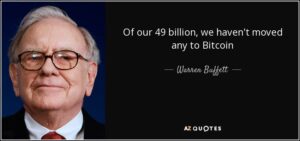
Warren Buffett, perhaps the most famous investor in the world, is not so keen on Bitcoin one of the only times he addressed the currency. “Stay away from it. It’s a mirage, basically,” he told CNBC. “The idea that it has some huge intrinsic value is a joke in my view.”
Fellow billionaire investor Jamie Dimon, chief executive of JPMorgan Chase, had even stronger words about Bitcoin: “You can’t have a business where people are going to invent a currency out of thin air. It won’t end well … someone is going to get killed and then the government is going to come down on it.”
Finance expert Martin Lewis said: “Bitcoin is a highly speculative investment. Putting money in it is a form of gambling.”
But not all billionaires are against Bitcoin. Mark Cuban has said its value is inflated, but he recently invested in a venture capital fund that backs cryptocurrency. Richard Branson, however, has spoken more optimistically about it.
In the end we can get back to one thing for sure that investing in Bitcoin is full of unmanageable uncertainties. There is no fundamental intrinsic value in the Bitcoin. We must invest in something which has an underlying value and not merely on the basis of rising prices.
But, if you are open for gambling or speculation then the game is yours….it may take you anywhere!. But, you can’t have a Financial Plan based on your bitcoin holding.
Please do write in comments if you like anything or want to suggest or add anything in the article..
Leave a Reply